.png&w=640&q=75)
Screen time, but meaningful: when the screen sends you outside
Few topics stir up as much parental guilt as screen time. Too much? Too little? The debate usually circles around minutes — and misses what matters more.
Not how much — but what for
Professional bodies like the American Academy of Pediatrics (AAP) are increasingly moving away from rigid time limits. What matters more than the sheer amount is what happens on the screen and in what context. A screen can make kids passive — endless scrolling, alone, indoors. Or it can open a door: to an idea, a conversation, a way outside.
The difference: consuming or acting
A simple rule of thumb for parents: does the screen make my child a spectator — or an actor? Watching a video is consumption. Searching, making, deciding as a team, going outside — that is acting. Both have their place, but the balance is what counts. And on one thing experts agree: screens shouldn't crowd out sleep, movement, family time and free play.
When the device sends you outside
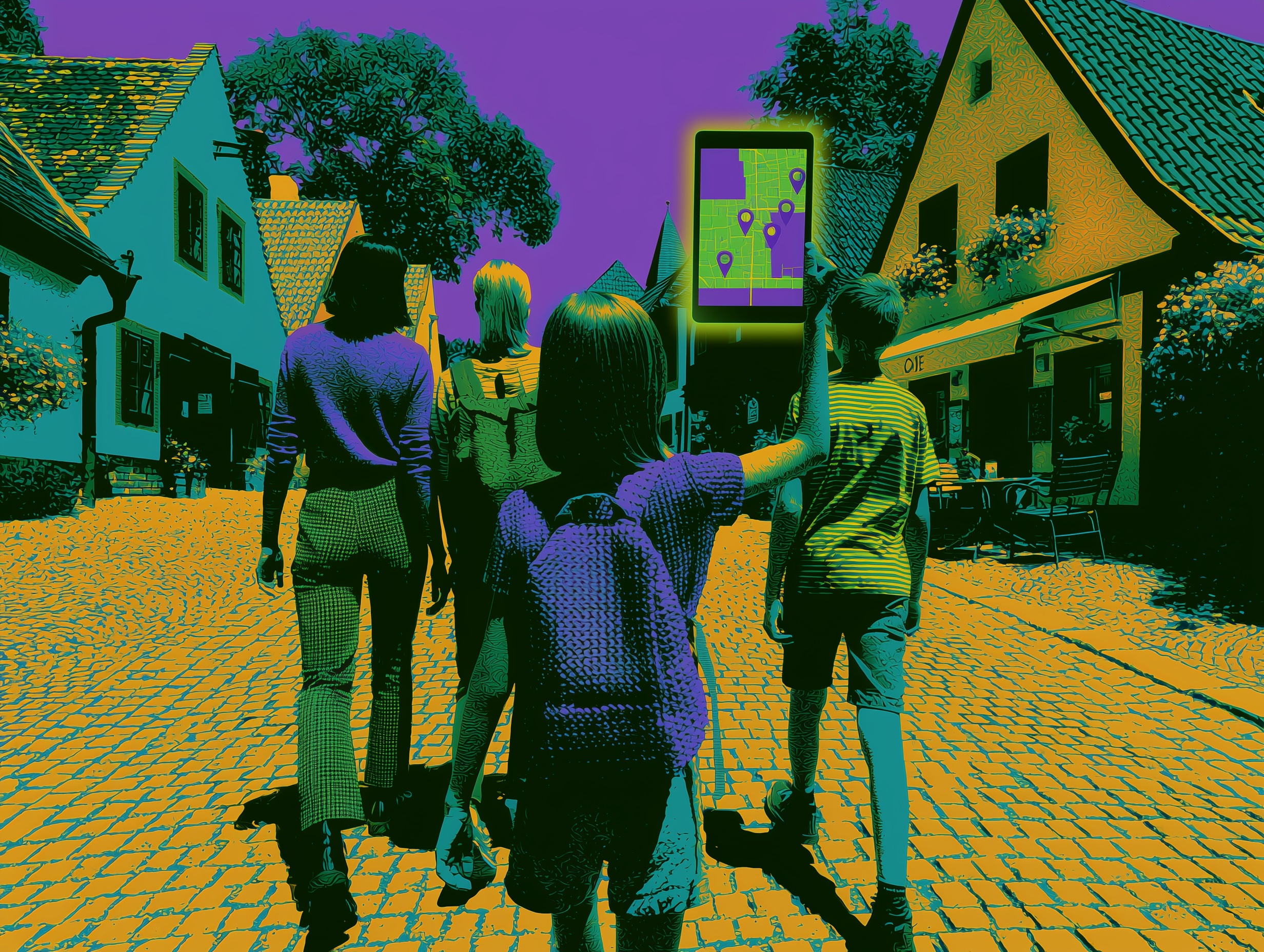
This is exactly where our idea for Localnauts comes in. The tablet comes along, but it doesn't keep the kids indoors: it sends them out into the real neighbourhood. During the trace scan, for example, they photograph something on site and only really discover it in the process — the screen connects the real world with the digital, instead of replacing it.
When every child gets to lead
And something else happens: the roles rotate as you go — one child navigates, another reads aloud, the next solves the puzzle. So every child takes the wheel at some point, including the younger ones who rarely get to lead the group. Reading the map, calling the way, deciding where to go: 'I've got the device, I'm allowed to use it — and together we solve the puzzle.' Screen time turns into self-efficacy. This shared, rotating way of leading is, quite incidentally, a real future skill — in a working world that increasingly runs on teams, shifting responsibility and collaboration. And a child who can find their way around their own neighbourhood feels safer and moves with more confidence.
What parents can do — without any dogma
Together rather than alone: watch along, play along, talk about it. Choose rather than merely limit: content that sparks something is worth more than counting minutes. Screen-free zones like the bed and the dinner table give structure. And deliberately add movement and the outdoors. No two children are the same — and guilt helps no one.
In the end it isn't about demonising or celebrating the screen, but about making it a tool that leads into life rather than out of it.
The interactive GPS scavenger hunt for families – now playable in Berlin-Rixdorf.
Frequently asked
Professional bodies like the American Academy of Pediatrics (AAP) are moving away from rigid minute limits: content and context matter more than the sheer amount. For school-age kids, the key point is that screens shouldn't crowd out sleep, movement, family time and free play.
Time in which the child acts rather than just watches — searching, making, deciding together or being led outside — and in which adults watch along or talk about it. Lonely, endless consumption is the opposite.
By making the device a tool that leads outside rather than tying kids indoors. A GPS scavenger hunt like Localnauts is one example: the tablet guides children through the real neighbourhood; they move, observe and decide as a team — the screen connects the real and digital worlds.