.png&w=640&q=75)
The Bohemian Village in Rixdorf — history explained for kids
In the middle of Berlin-Neukölln, around Richardplatz, lies a village within the city: the Bohemian Village in Rixdorf. Cobblestones, old courtyards, a smithy that has worked for centuries — and a history that goes back a long way.
In short: the Bohemian Village in Berlin-Neukölln (Rixdorf) began in 1737, when the king bought the Rixdorf manor farm, had nine semi-detached houses built and settled eighteen Bohemian families there — invited by the Prussian king Friedrich Wilhelm I. Around Richardplatz, the courtyards, the smithy, the Bethlehem Church and the Bohemian burial ground survive to this day and are free to explore.
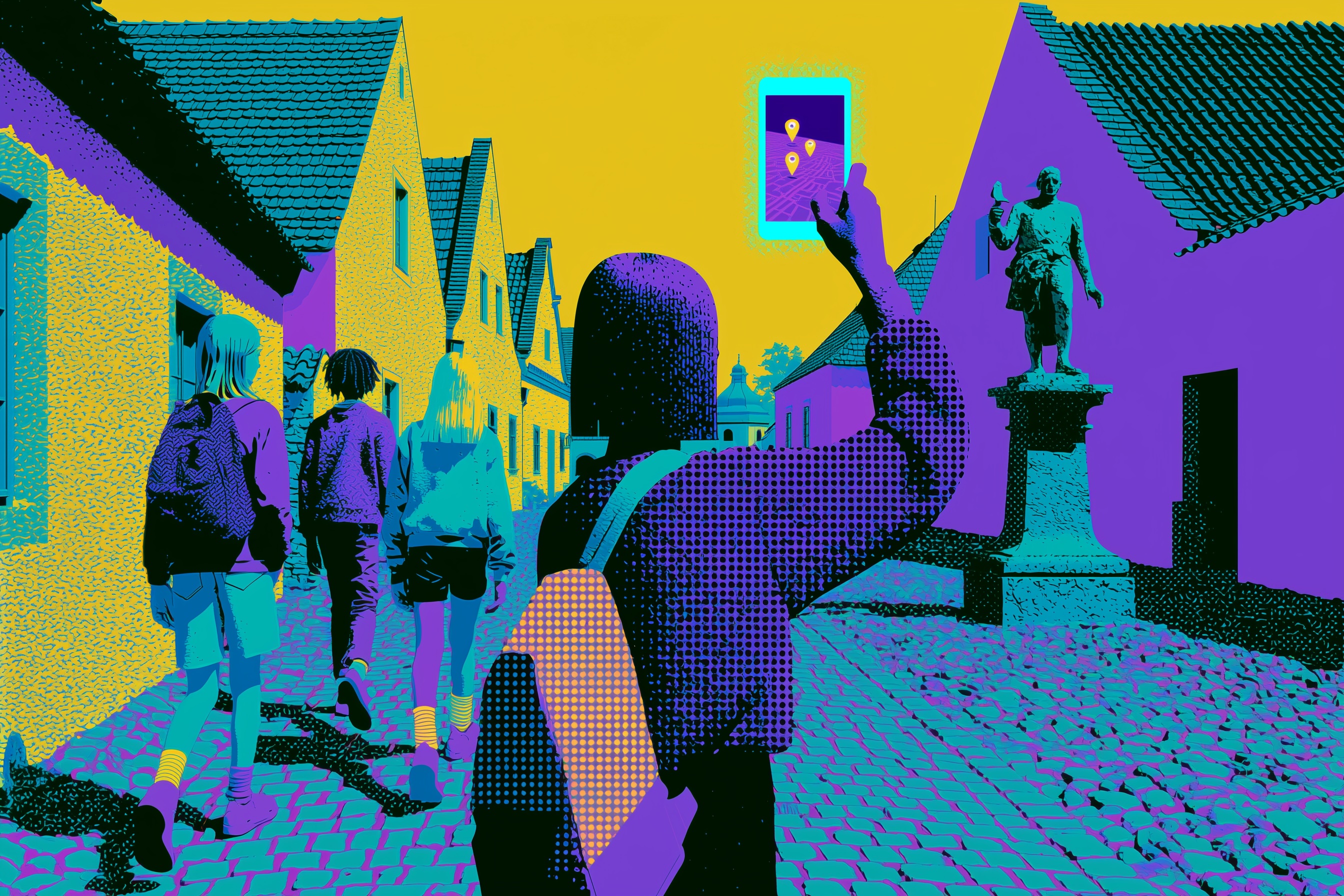
Even older than the Bohemian Village: 1360
Rixdorf is much older than the Bohemian Village. The village core — then called Richardsdorp — is first mentioned in a document on 26 June 1360, when the Order of St John turned an estate into a village. That makes Rixdorf one of Berlin's oldest village cores. Only around 375 years later, in 1737, did the Bohemian families arrive — and that is how Böhmisch-Rixdorf came about.
1737: how the Bohemian Village began
In 1737 King Friedrich Wilhelm I of Prussia bought the Rixdorf manor farm and had nine semi-detached houses with barns built there — for eighteen selected Bohemian families, almost all from the town of Böhmisch-Rothwasser. They received semi-detached houses and barns, horses, cows and farm tools, and stayed tax-free for several years.
The king also had an economic motive: the Thirty Years' War and the plague had left Prussia depopulated. The newcomers were farmers and weavers at once — in the fields by day, at the loom in the evening.
A language of their own in the middle of Berlin
The Bohemian community kept its independence for a long time: its own self-government, its own congregations — and its language. Church services were held in Czech until the First World War. Today's Kirchgasse was called Malá ulička, the little lane, until 1909. And to this day the Czech song Čas radosti is sung at Christmas.
'Bohemian villages'? What the saying means
In German there is a saying — 'das sind für mich böhmische Dörfer' (literally 'those are Bohemian villages to me') — meaning something you simply cannot make sense of, a mystery, much like the English 'it is all Greek to me'. It goes back to German-speaking travellers who could neither pronounce nor understand the Czech names of Bohemia's villages; so 'Bohemian villages' became shorthand for anything foreign and baffling. The lovely thing in Neukölln: here the Bohemian Village is not a mystery but a place you can visit and understand.
Traces you can still find today
Much has survived: the Rixdorf smithy, documented since 1624 and one of the oldest working smithies in Berlin. The Bethlehem Church, the oldest building in Rixdorf, with an orb on its spire — such tower orbs often served as time capsules. Plus the Museum in the Bohemian Village at Kirchgasse 5, the Comenius Garden, and the Bohemian burial ground, one of Berlin's oldest continuously used cemeteries.
Why it still matters today
The story of the Bohemian Village is about people who left their home and started again elsewhere — because they were invited and needed. Such journeys still happen today: people move to where they find safety, work or a future. Rixdorf shows children that strangers can become neighbours, and that ordinary families built a place that still exists. That is where good conversations begin: Why do people leave home? Who decides who is allowed to come — and with what interest? What makes a place feel like home?
It isn't about memorising dates — it's about understanding people and their stories.
History to discover for yourself
These are exactly the places Localnauts turns into a playing field: kids travel back to 1737 as a crew and solve puzzles at ten stations — in the middle of it, not in a book. Every historical fact is backed by a source; where something is handed down rather than proven, we say so honestly. All the evidence is public on our sources page.
History isn't only in the museum — it's in the cobblestones, the street names and the alleyways.
The interactive GPS scavenger hunt for families – now playable in Berlin-Rixdorf.
Frequently asked
The Bohemian Village is a historic centre around Richardplatz in Berlin-Neukölln (Rixdorf). From 1737, Protestant religious refugees from Bohemia settled here. Many courtyards, the smithy, the Bethlehem Church and the Bohemian burial ground survive to this day.
The village core of Rixdorf (Richardsdorp) is first mentioned on 26 June 1360, when the Order of St John turned the estate into a village — one of Berlin's oldest village cores. The Bohemian Village came later: from 1737, Bohemian religious refugees arrived in Rixdorf.
Because alongside the older German Rixdorf, an independent Bohemian community formed from 1737 — with its own self-government and the Czech language. The two parts were united in 1874 and renamed Neukölln in 1912.
Yes. With Localnauts the neighbourhood becomes a GPS scavenger hunt for kids aged 8 to 12: at ten stations they solve puzzles and experience the real history on site — about 120–180 minutes incl. intro and breaks, as a web app in the browser — nothing to download from an app store.
'Das sind für mich böhmische Dörfer' means something is utterly incomprehensible — a mystery, much like the English 'it's all Greek to me'. It arose because German-speaking travellers could neither pronounce nor understand the Czech names of Bohemia's villages.
From German speakers who found the many Czech village names in Bohemia unpronounceable and baffling — so 'Bohemian villages' became shorthand for anything foreign and hard to grasp. In Rixdorf, though, the Bohemian Village is real and very much knowable.